DARPA’s own words paint the clearest picture yet of a fully integrated pre-COVID pandemic U.S. military system that can:
take only a digital sequence of a virus
synthesize an infectious clone
grow it in a “Thaw-and-Infect” panel of human and animal cell lines
isolate antibodies from infected blood
evolve those antibodies using computational mutation engines
encode those antibodies into modified mRNA
package them in lipid nanoparticles
and produce 20,000 doses within 60 days
The program is open about building a platform that works even when no physical virus exists, only a computer file.
This
newly released document directly reinforces my own research
findings—showing that the Wuhan-Hu-1 spike (COVID-19 spike protein),
assembled entirely in silico and containing a non-coronavirus-derived
mosaic, fits precisely within the digital-first,
synthetic-construction pandemic pipeline DARPA had already built before
COVID-19 emerged.
And it was precisely this computationally stitched sequence—first published by Wu et al. in Nature
(February 2020) without any purified viral isolate or plaque-verified
spike protein—that became the official worldwide “reference” antigen
used for diagnostics, modeling, mRNA vaccine design, and every
subsequent COVID-19 countermeasure.
The
DARPA document suggests the disturbing possibility that the COVID-19
“pandemic” may have originated not from a naturally circulating virus,
but from a computationally generated sequence that was subsequently
treated as a real pathogen and mass-manufactured into international
medical countermeasures (“vaccines”).
And
because this digitally assembled spike became the sole antigen used by
Pfizer and Moderna, the world’s first mass-distributed mRNA vaccines
could have effectively programmed billions of human bodies to
manufacture the same engineered, domain-modular construct that DARPA’s
biodefense pipeline, UPenn’s antibody-engineering platform, and Baric’s
NIH-funded chimeric coronavirus system had already optimized long before
COVID was declared a pandemic.
In other words, billions
of people may have been injected with instructions to manufacture a
synthetic, digitally designed spike protein born not from nature, but
from a Pentagon–NIH engineering pipeline.
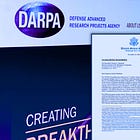
Everything quoted below is verbatim from the FOIA document (HROO11-17-2-0069).
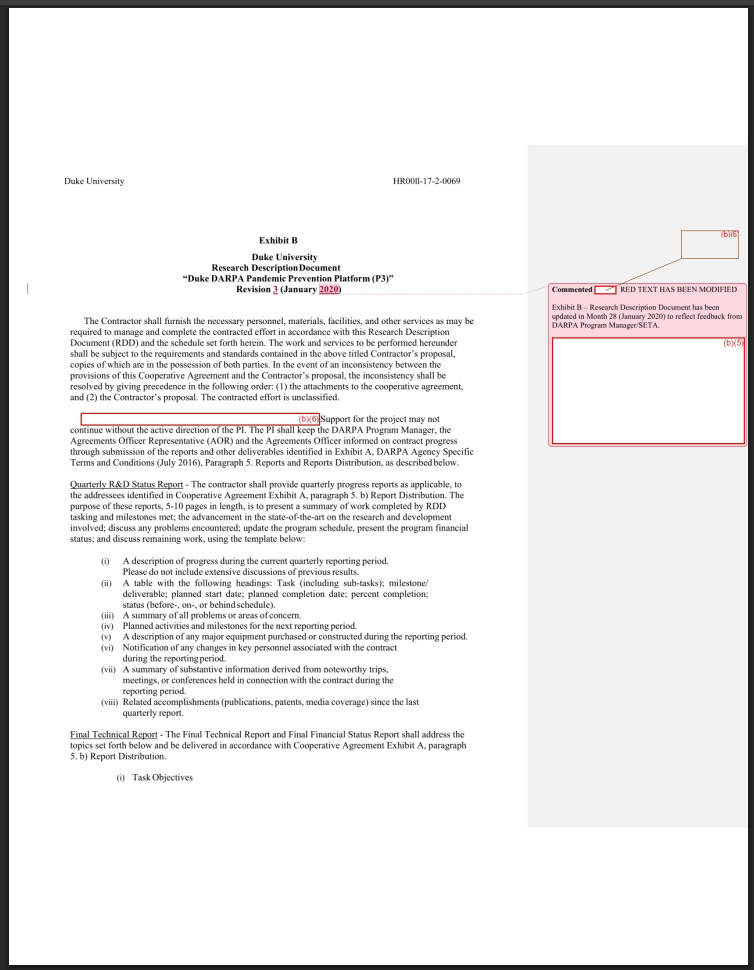
 | 21 F 0004 09 9.85MB ∙ PDF file |
|
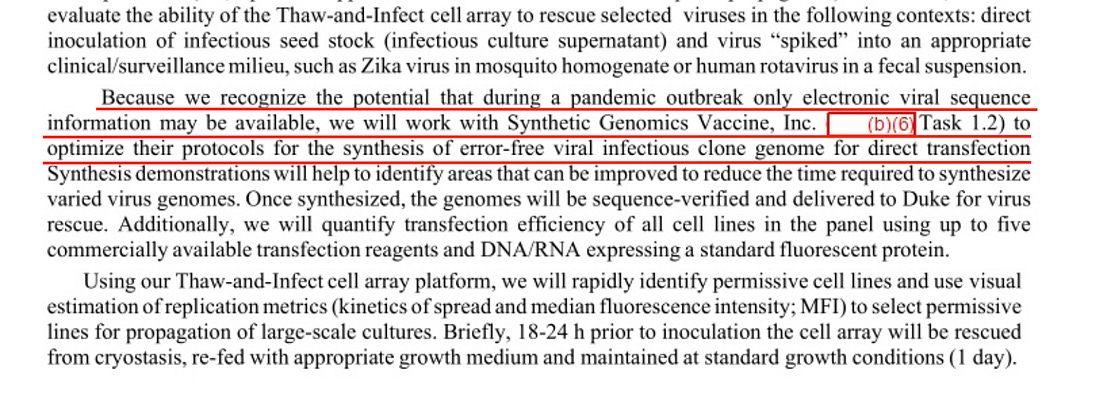
DARPA explicitly instructs its contractors to prepare for pandemics where no real virus is ever provided:
“Because
we recognize the potential that during a pandemic outbreak only
electronic viral sequence information may be available, we will work
with Synthetic Genomics Vaccine, Inc. to optimize their protocols for
the synthesis of error-free viral infectious clone genome for direct transfection.”
In plain terms, DARPA expected outbreaks where governments supply genome files instead of biological agents, requiring U.S. laboratories to fabricate the infectious agent themselves.
My own 2025 original research papers (The SARS-CoV-2 Reference Spike, and A 32% Human-Derived Mosaic in the In Silico-Assembled SARS-CoV-2 Spike Protein) demonstrate that the Wuhan-Hu-1 (COVID-19 spike protein) spike was built digitally, assembled from bronchoalveolar lavage RNA via un-blinded metagenomic pipelines without human-sequence exclusion.
DARPA’s
insistence that full pandemic response must function when “only
electronic viral sequence information” exists directly affirms the core
premise of Fleetwood’s findings: modern biodefense systems treat digital code as a virus, converting computational constructs into physical biological entities.
The FOIA document reveals that DARPA was funding workflows where a virus is born as data,
and only afterward turned into an infectious clone—the same conceptual
pathway through which the 32% human-derived mosaic spike emerged.
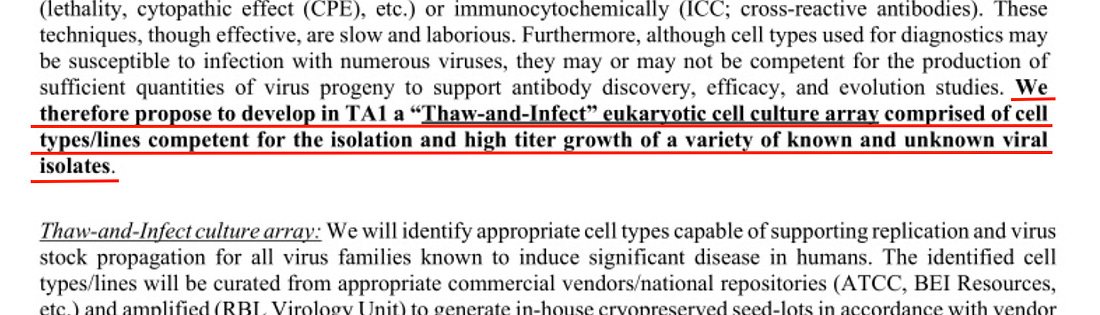
DARPA
required Duke to maintain a frozen library of high-density human,
animal, and immortalized cell lines capable of instantly growing nearly
any virus—even ones with unknown identity:
“We
therefore propose to develop in TAI a ‘Thaw-and-Infect’ eukaryotic cell
culture array comprised of cell typesilines competent for the isolation
and high titer growth of a variety of known and unknown viral
isolates.”
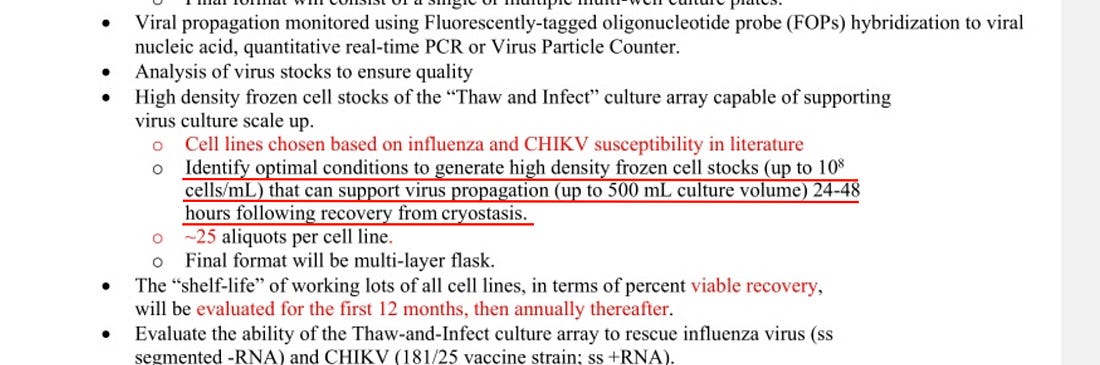
And:
The
document proposes to “Identify optimal conditions to generate high
density frozen cell stocks (up to 10* cells/mL) that can support virus
propagation (up to 500 mL culture volume) 24-48 hours following recovery
from cryostasis.”
This is a plug-and-play virus amplification factory—a universal propagation system for both natural and engineered pathogens.
DARPA
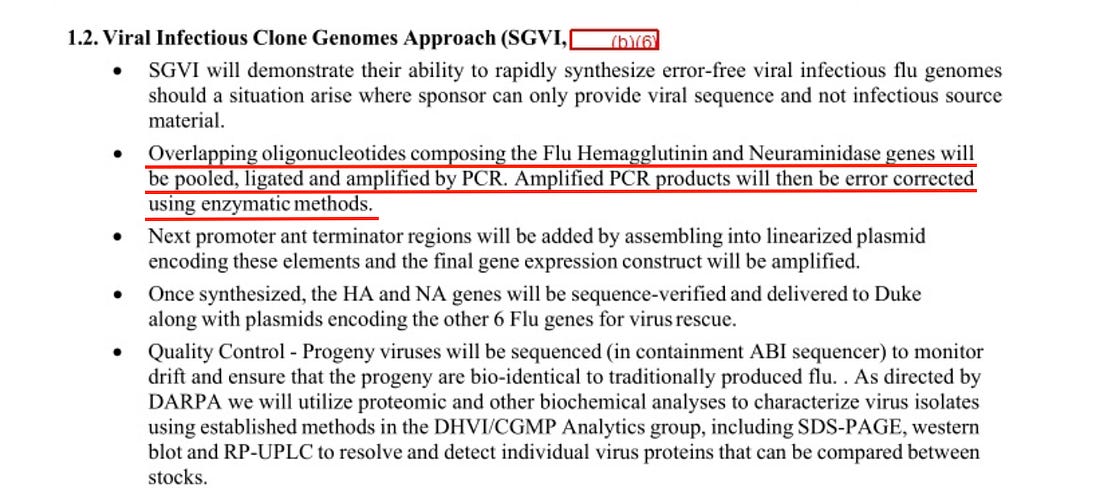
contracted Synthetic Genomics (SGI)—now part of Codex DNA—to assemble
influenza and other viruses by stitching together DNA fragments:
“Overlapping oligonucleotides… will be pooled, ligated and amplified… error corrected… assembled into linearized plasmid… and delivered… for virus rescue.”
An oligonucleotide is a short, synthetically manufactured piece of DNA or RNA.
This is identical to modern gain-of-function synthetic reconstruction workflows.
My A 32% Human-Derived Mosaic paper argues that the Wuhan-Hu-1 spike mirrors exactly the type of molecule produced by the patented “modular domain substitution” framework in Ralph Baric’s “Methods and compositions for chimeric coronavirus spike proteins” patent US9884895B2.
DARPA’s description of error-corrected assembly via overlapping oligos shows that U.S. programs were routinely generating error-free synthetic viral genomes, matching the precision and modular organization seen in my proposed 32% human-derived mosaic spike.
The
Wuhan-Hu-1 spike’s highly ordered placement of human motifs across each
pre-engineered domain becomes far more plausible in a system where
infectious clones are built, not isolated.
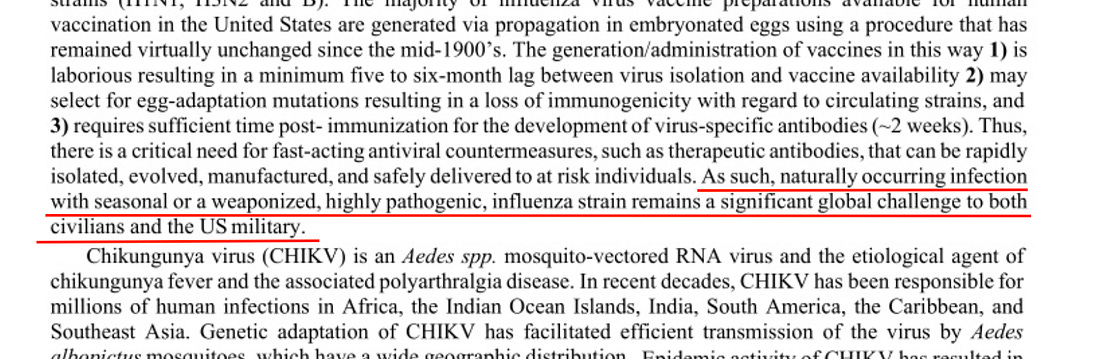
DARPA openly references engineered flu strains as realistic scenarios:
“seasonal or a weaponized, highly pathogenic, influenza strain remains a significant global challenge…”
This appears under “Justification of Pathogens.”
My
original research papers show that the spike protein’s functional
domains align with synthetic engineering practices developed under
NIH-funded coronavirus research.
DARPA’s explicit reference to weaponized strains demonstrates that the U.S. biodefense establishment assumes the existence of engineered pathogens requiring rapid reconstruction and countermeasure systems.
The
Wuhan-Hu-1 spike—a modular chimera built from human and coronavirus
segments, according to my analyses—aligns squarely with the design space
DARPA anticipated.
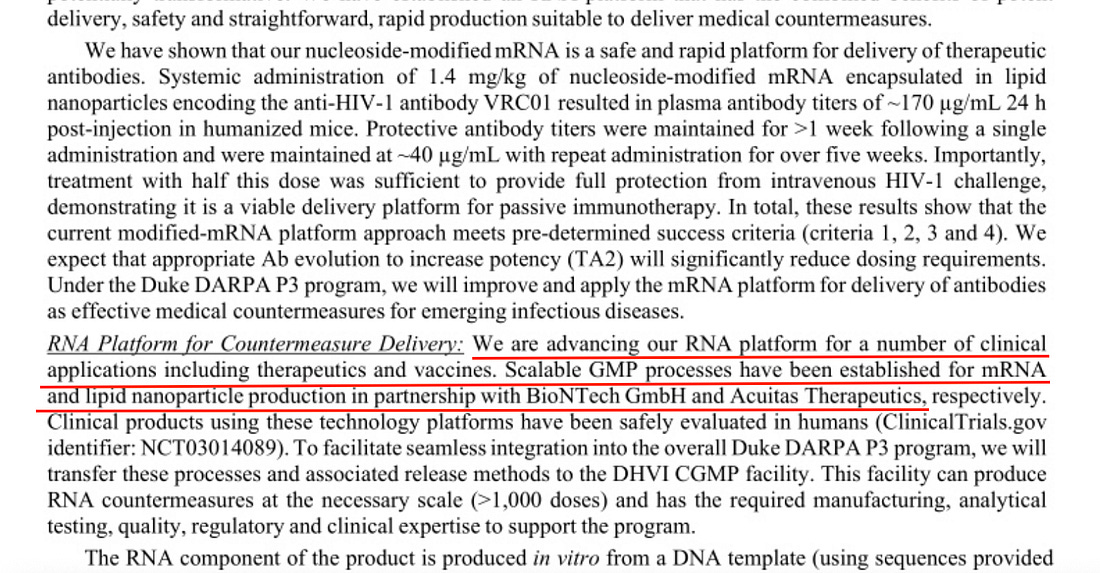
DARPA confirms that its mRNA countermeasure (vaccine) system was developed in partnership with BioNTech and Acuitas, the same companies behind the Pfizer COVID-19 vaccine:
“We are advancing our RNA platform
for a number of clinical applications including therapeutics and
vaccines. Scalable GMP processes have been established for mRNA and
lipid nanoparticle production in partnership with BioNTech GmbH and Acuitas Therapeutics.”
This was January 2020.
Before the first public COVID vaccine concepts.
My papers document that the in silico spike—never purified or isolated—became the global mRNA vaccine antigen.
DARPA’s
acknowledgment that BioNTech and Acuitas were already integrated into
pre-pandemic mRNA production pipelines shows that an infrastructure
existed where any uploaded gene sequence could rapidly become an LNP-mRNA product.
This
is precisely what happened: the computationally assembled Wuhan-Hu-1
spike instantly became the world’s vaccine antigen because the
pandemic-response system was engineered to convert digital sequences into mRNA countermeasures.
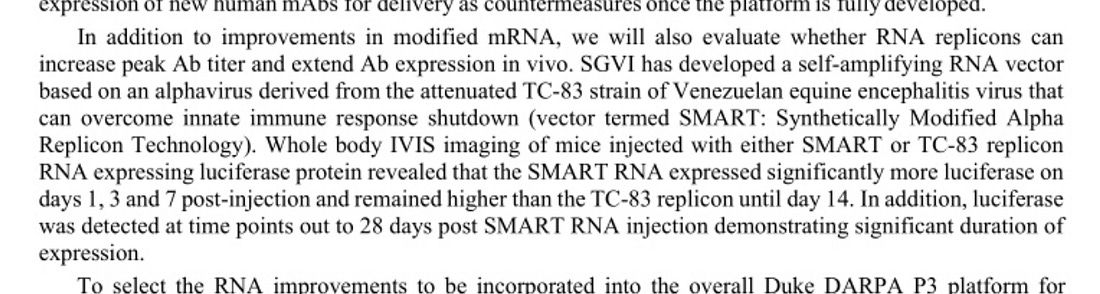
DARPA’s program incorporates saRNA replicons:
“In
addition to improvements in modified mRNA, we will also evaluate
whether RNA replicons can increase peak Ab titer and extend Ab
expression in vivo. SGVI has developed a self-amplifying RNA vector
based on an alphavirus derived from the attenuated TC-83 strain of
Venezuelan equine encephalitis virus that can overcome innate immune
response shutdown (vector termed SMART: Synthetically Modified Alpha
Replicon Technology). Whole body IVIS imaging of mice injected with
either SMART or TC-83 replicon RNA expressing luciferase protein
revealed that the SMART RNA expressed significantly more luciferase on
days 1, 3 and 7 post-injection and remained higher than the TC-83
replicon until day 14. In addition, luciferase was detected at time
points out to 28 days post SMART RNA injection demonstrating significant
duration of expression.”
This predates public awareness of saRNA platforms.
DARPA describes its end-to-end plan:
“Across
the 30-month program we will develop a fully-integrated end-to-end
platform that can start with unknown samples from a viral outbreak and
be prepared to produce an efficacious and safe CGMP medical
countermeasure scalable to 20,000 doses within 60 days.”
The central claim of my original research is that the SARS-CoV-2 spike was produced via an in-silico-to-synthetic-biology pipeline rather than purified from nature.
DARPA’s 60-day manufacturing concept relies on exactly such digital-to-mRNA transformation workflows.
The fact that DARPA required a system capable of producing tens of thousands of doses from only sequence data validates the environment in which the Wuhan-Hu-1 spike emerged: a digital sequence was treated as a ready-made antigen.
Within days of Wu et al. uploading their computer-assembled spike to public databases, Moderna and Pfizer had already converted
that digital construct into mRNA vaccine designs—treating an
unpurified, in silico sequence as if it were a fully characterized
biological antigen.
This FOIA document exposes a U.S. military program designed to:
take a digital file
synthesize an infectious clone
propagate it in universal cell arrays
extract and computationally evolve antibodies
encode them in synthetic RNA
package them in LNPs
and mass-produce mRNA countermeasures in weeks
All before SARS-CoV-2 was publicly known.
When
viewed side-by-side with Fleetwood’s research findings, the DARPA P3
document does not merely contextualize the mosaic spike—it confirms its plausibility, providing the operational framework in which a 32% human-derived chimeric spike built from digital assembly becomes not only possible, but expected.
Taken together, the evidence suggests the
world may not have experienced a natural viral pandemic, but a global
biological rollout built around a digitally assembled spike protein that
became the foundation for diagnostics, modeling, and the mass
vaccination campaign itself.
Share
Share Jon Fleetwood
Message Jon Fleetwood
 Wie van ons weet dat als je dagelijks omgaat met kassabonnen dat dit niet echt goed is voor je gezondheid.